The Federal Fish Counter Who Kept Clocking In Decades After His Fish Disappeared
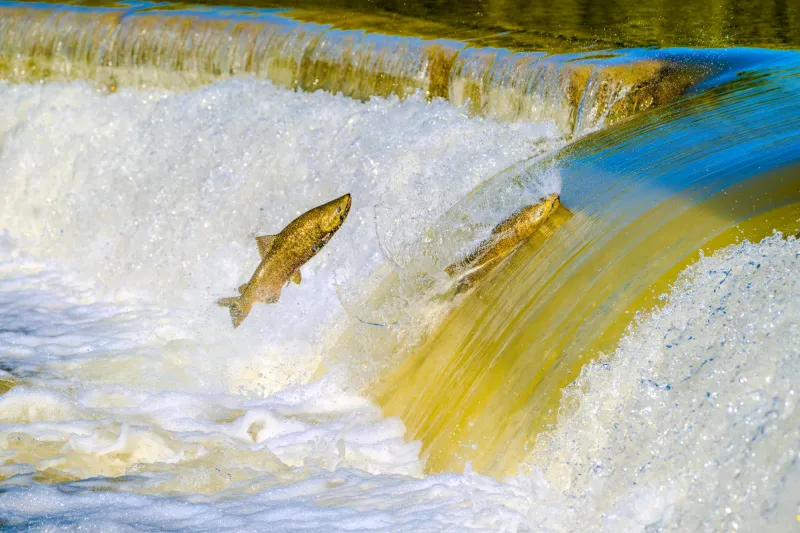
The Job That Outlived Its Purpose by Three Decades
In 1923, the newly formed U.S. Fish and Wildlife Service faced a problem that seemed straightforward enough: Pacific Northwest salmon populations were declining, and someone needed to keep track of exactly how bad things were getting. So they hired Dr. Harold Whitman, a marine biologist from Oregon State, to monitor the salmon runs in the Clearwater River.
It was supposed to be temporary work — maybe five years, ten at most. Just long enough to gather data and figure out what was killing the fish.
By 1935, Whitman had his answer: the fish were gone. Not declining. Not struggling. Gone.
But here's where the story gets weird. Whitman kept showing up to work. And the government kept paying him. For another 30 years.
When Success Means Admitting Failure
The Clearwater River salmon population collapsed for all the usual reasons — overfishing, habitat destruction, and the construction of several small dams that blocked migration routes. Whitman dutifully documented every stage of the decline in his quarterly reports, which he filed religiously with the regional Fish and Wildlife office in Portland.
The problem was that nobody at Fish and Wildlife wanted to be the person who officially declared the monitoring program a failure. Shutting down Whitman's position would mean admitting that an entire salmon population had been lost on their watch. It would mean explaining to Congress why they'd spent a decade watching fish disappear without doing anything to stop it.
So instead, they just... kept the program running.
The Art of Counting Nothing
Whitman's job description never technically changed. He was still required to conduct weekly fish counts, measure water temperature and quality, and file detailed reports on salmon behavior and population trends.
The only difference was that there were no salmon to count.
This presented a unique professional challenge. How do you spend eight hours a day monitoring fish that don't exist? Whitman, apparently, was nothing if not creative.
His reports from the 1940s and 1950s make for fascinating reading. They're filled with meticulous observations about water conditions, weather patterns, and theoretical discussions about what the salmon population might look like if it still existed. He began including detailed analyses of why no fish were present on any given day, complete with charts and graphs showing the consistent absence of salmon over time.
One 1947 report includes a 12-page section titled "Behavioral Patterns of Non-Existent Salmon During Spawning Season." Whitman had essentially turned the documentation of nothing into a science.
The Bureaucracy That Couldn't Stop Itself
Meanwhile, back in Portland, Fish and Wildlife administrators found themselves trapped in an increasingly absurd situation. Whitman's salary came from a specific Congressional appropriation for "Pacific Northwest Salmon Population Monitoring." Ending the program would require them to return unused funds to Congress and explain why the money was no longer needed.
But returning the money would mean admitting that the entire salmon population had been lost. And admitting the salmon were gone would raise uncomfortable questions about why Fish and Wildlife had failed to prevent their extinction in the first place.
So year after year, administrators simply renewed Whitman's contract and filed his reports in a drawer somewhere. The program became a bureaucratic zombie — officially alive, functionally dead, and impossible to kill.
The Man Who Made a Career Out of Nothing
Whitman, for his part, seems to have understood exactly what was happening. By the 1950s, his reports began including subtle commentary on the absurdity of his situation. One 1953 filing includes the note: "Week 847 of salmon monitoring. No salmon observed, as expected. Recommend continued vigilance."
He began branching out, using his position to conduct unauthorized research on other aspects of river ecology. His 1955 report on Clearwater River insect populations is still cited by entomologists today. His 1958 study of seasonal water temperature variations became a foundational document for understanding Pacific Northwest stream ecology.
In effect, Whitman had transformed his pointless job into genuine scientific work — just not the work he was officially being paid to do.
The End of an Era
The salmon monitoring program finally ended in 1965, not because anyone at Fish and Wildlife decided to shut it down, but because Whitman retired. At his retirement party, colleagues presented him with a plaque reading "30 Years of Dedicated Service" and a mounted photograph of an empty river.
The program's budget line remained active for another two years while administrators tried to figure out what to do with it. Eventually, they quietly transferred the funds to a general "river monitoring" program and pretended the whole thing had never happened.
The Legacy of Counting Nothing
Whitman's story might sound like an indictment of government waste, but it actually reveals something more interesting about how bureaucracies work. The system that kept him employed for 30 years wasn't designed to be wasteful — it was designed to avoid admitting mistakes.
In the end, taxpayers got their money's worth. Whitman's decades of "monitoring nothing" produced valuable research on river ecology, documented the complete collapse of a salmon population in unprecedented detail, and created a cautionary tale about what happens when environmental protection becomes a paperwork exercise.
Plus, it gave us one of the most beautifully absurd job titles in federal employment history: Senior Salmon Population Specialist (Non-Existent Fish Division).
Whitman apparently had business cards made.