The Ghost Base: How the Army Spent 30 Years Guarding an Empty Desert
The Loneliest Assignment in America
For thirty years, fresh-faced Army privates received orders to report to Forward Supply Depot Charlie-7, a remote munitions storage facility in the Nevada desert. They arrived expecting to guard America's military secrets, only to find themselves protecting absolutely nothing.
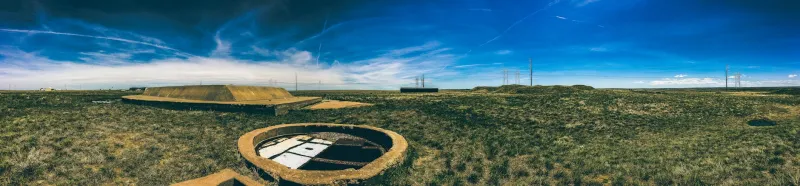
 Photo: Forward Supply Depot Charlie-7, via forwardsupplyco.com
The depot consisted of forty-three concrete bunkers scattered across 2,400 acres of scrubland, each one completely empty. No weapons, no ammunition, no classified materials — just decades of accumulated dust and the occasional tumbleweed.
Yet the orders kept coming. Security rotations continued. Maintenance crews arrived quarterly to service non-existent equipment. The Army's logistics command faithfully allocated $340,000 annually to operate a facility that had been decommissioned during the Johnson administration.
The Depot That Time Forgot
Forward Supply Depot Charlie-7 was built in 1943 to store artillery shells and explosives for Pacific Theater operations. After the war, it housed nuclear weapons components during the early days of the Cold War. But by 1963, newer facilities had made Charlie-7 obsolete.
The decommissioning process began that summer. Over eighteen months, military contractors carefully removed every piece of equipment, every round of ammunition, and every classified document. By February 1965, the depot was officially empty and transferred to "caretaker status" — military speak for abandoned but not quite forgotten.
That's where the paperwork problems began.
A Tale of Two Filing Systems
The Army's base management system in the 1960s was a bureaucratic maze that would have impressed Franz Kafka. Different administrative functions used different coding systems, and Charlie-7 got caught between them.
The depot was listed under two separate designations: "FSC-07" in the facilities management database and "Supply Point 447" in the personnel assignment system. When the 1965 decommissioning order was filed, it only updated the facilities database. The personnel system kept right on assigning people to Supply Point 447, which as far as the computer knew, was still an active munitions depot requiring round-the-clock security.
This wasn't discovered until 1994, when a Government Accountability Office audit finally cross-referenced the two systems and found the discrepancy.
The Routine That Nobody Questioned
Meanwhile, for three decades, Charlie-7 operated like clockwork despite having no actual mission.
Every six months, a new security detail arrived to replace the previous one. They received standard briefings about the importance of their mission and the sensitivity of the materials they were protecting. Then they spent their deployment walking empty bunkers and filing reports about nothing happening.
Most assumed the depot contained classified materials so secret that even the guards weren't allowed to know what they were guarding. This wasn't uncommon in military installations during the Cold War, so nobody asked too many questions.
The maintenance contracts were equally surreal. Quarterly inspections covered electrical systems that powered nothing, ventilation equipment that circulated air through empty rooms, and security cameras that monitored vacant concrete structures.
The Paper Trail That Wouldn't Die
The most remarkable aspect of Charlie-7's ghost operation was how it survived multiple attempts to shut it down — attempts that never actually happened because nobody realized it needed to be shut down.
In 1973, the Pentagon conducted a comprehensive review of Cold War-era facilities. Charlie-7 appeared on the list as "FSC-07: Decommissioned 1965." Check mark, move on.
In 1985, another review looked at active personnel assignments. Charlie-7 showed up as "Supply Point 447: Active security detail." Check mark, move on.
A third review in 1991 focused on maintenance contracts. Charlie-7 was listed as "Facility requires ongoing maintenance per security protocols." Check mark, move on.
Each review committee assumed the others had already verified Charlie-7's status. None of them actually visited the site or questioned why an empty depot needed armed guards.
Life at the Edge of Nowhere
Declassified personnel records reveal what life was like for the soldiers assigned to guard nothing.
The duty was simultaneously boring and stressful. Boring because absolutely nothing ever happened. Stressful because the guards knew their careers could be ruined if something went wrong on their watch — even though there was literally nothing that could go wrong.
Some guards developed elaborate theories about what they were really protecting. Popular hypotheses included alien technology, experimental weapons, and government gold reserves. A few became convinced that the empty bunkers were a psychological test designed to measure their dedication to duty.
One former guard, interviewed years later, described the experience as "like being a museum security guard, except the museum had no exhibits and you weren't allowed to tell anyone it was a museum."
The Discovery
The truth finally came out during a routine budget review in 1994. A newly hired GAO analyst noticed that Charlie-7 appeared in multiple budget categories with conflicting status descriptions. When she tried to reconcile the discrepancies, she discovered that the facility had been simultaneously decommissioned and fully operational for nearly thirty years.
The final inspection team that arrived to officially close Charlie-7 found bunkers filled with decades of meticulously filed security reports documenting the complete absence of any security threats. The last entry, dated three days before the shutdown, noted "All sectors secure. No unusual activity observed."
The Cost of Institutional Inertia
Over thirty years, the Army spent approximately $10.2 million operating Charlie-7. This included salaries for 180 different security personnel, maintenance contracts, utilities for empty buildings, and transportation costs for supplies that served no purpose.
The depot was finally, officially closed on December 15, 1994. The last security detail was reassigned to actual facilities with actual missions. The maintenance contracts were terminated. The empty bunkers were sealed and abandoned to the desert.
The Unlikely Truth About Bureaucracy
Charlie-7 represents something more profound than simple government waste. It reveals how large institutions can develop a momentum that becomes independent of their original purpose.
For three decades, hundreds of people participated in an elaborate performance of military readiness without anyone stepping back to ask what they were actually accomplishing. The system worked perfectly — it just wasn't accomplishing anything.
Today, the former Forward Supply Depot Charlie-7 sits empty in the Nevada desert, guarded only by "No Trespassing" signs and the occasional coyote. It's finally serving its intended purpose: being completely ignored by the United States Army.