A Hoosier Town Named Santa Claus Broke the Law Every December for a Century — Nobody Noticed Until 2019
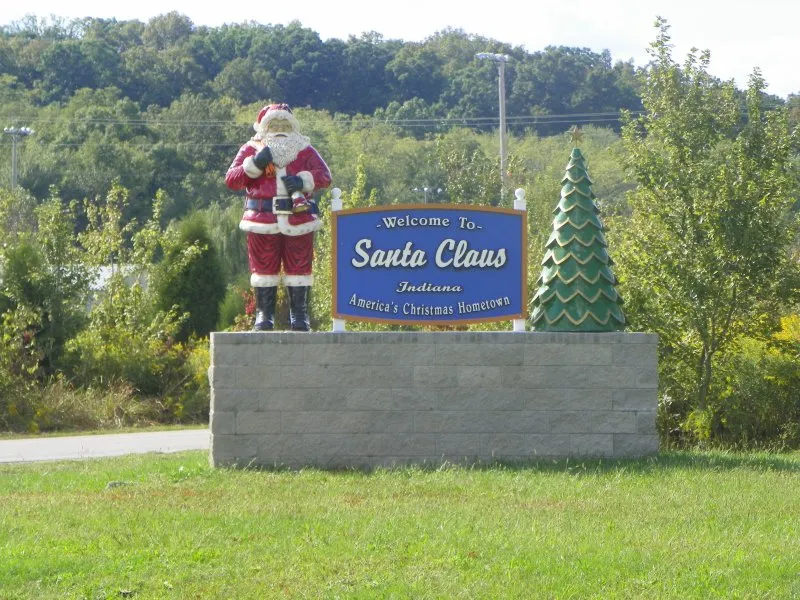
Photo: Sarah Afshar, CC BY-SA 3.0, via Wikimedia Commons
Every December, the town of Santa Claus, Indiana, lights up like a postcard. There's a Christmas Lake, a Santa's Lodge, a theme park called Holiday World, and a post office that receives thousands of letters addressed to a man in a red suit. It is, by any measure, the most Christmas-obsessed town in America.
It was also, on paper, breaking the law the entire time.
The Statute Nobody Read
In 1907, the Indiana General Assembly passed a law regulating public entertainment on Sundays — a blue law of the era, aimed at keeping the Sabbath quiet. Buried in the language was a provision prohibiting public festivals, performances, and celebrations on Sundays that fell on certain dates, and legal scholars later noted that the statute's wording, as applied to public holiday observances involving paid entertainment, technically criminalized the kind of ticketed Christmas festivities Santa Claus had become famous for.
For decades, the law sat in the Indiana Code like a landmine no one stepped on. The town held its parades. The park sold its tickets. The county attorney's office had better things to do than prosecute Christmas.
The Law Student Who Wouldn't Let It Go
Enter a retired law student — ahoosier named Gerald Fritch, who in the late 2010s was reading old statutes for fun (yes, for fun) and stumbled across the provision. He did what any self-respecting legal nerd would do: he checked whether it had been repealed.
It hadn't.
Fritch wrote to the town council, then to a state legislator, pointing out that Santa Claus, Indiana — a town literally named after the holiday — was technically in violation of its own state's code every single December. The letter made its way through the usual government channels, which is to say slowly, and then all at once once a local paper picked it up.
The Quiet Scramble
What followed was a masterclass in low-drama legislating. A state representative sponsored a clean-up bill. Nobody wanted to be photographed voting against Christmas in the town of Santa Claus, so the repeal sailed through with bipartisan support and almost no debate. The statute that had haunted the town for a century was struck from the books with the legislative equivalent of a shrug.
Town officials, for their part, had a consistent position throughout: they'd never heard of the law, never enforced it, and never planned to stop celebrating. One council member reportedly noted that if the state wanted to arrest the entire population of Spencer County in December, it was welcome to try.
Why It Matters
Blue laws are common; unenforced blue laws are commoner still. What makes this one special is the irony engine behind it. Indiana didn't just have an anti-Christmas law on the books — it had one being violated enthusiastically, publicly, and commercially by a town whose zip code is a punchline. The law survived Prohibition, two world wars, and the invention of the theme park, and it survived all of them because absolutely no one with enforcement power cared.
Today, Santa Claus, Indiana, remains open for business every December, fully legal and fully lit. The letters to Santa still arrive by the thousands. And somewhere in the state archives sits the ghost of a statute that spent a hundred years losing an argument it never knew it was having.