For Over a Decade, One Federal Employee Spent His Days Counting Livestock That Someone Else Was Already Counting
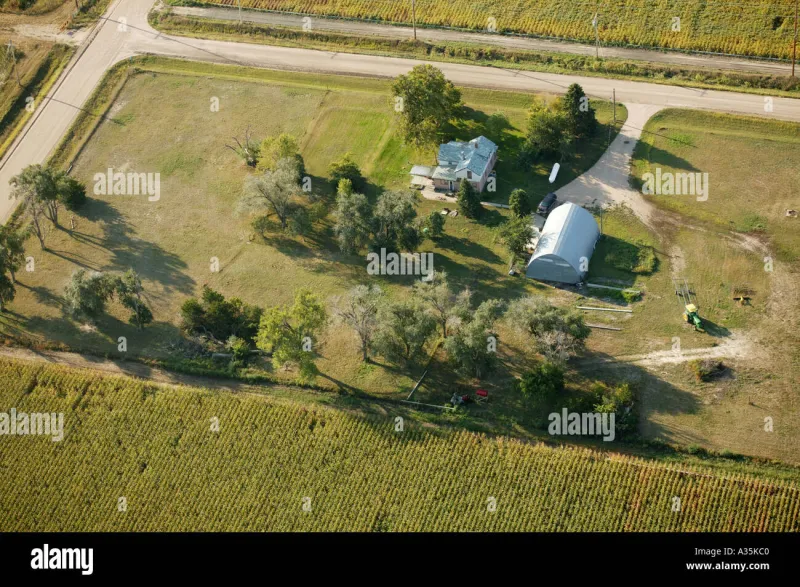
Photo: 1950s rural Nebraska farmland cattle livestock aerial view, via c8.alamy.com
There is a particular species of bureaucratic absurdity that only the mid-20th century federal government could have produced. It required the right combination of overlapping New Deal programs, wartime administrative expansion, and postwar inertia — a system so large and so layered that its left hand genuinely could not see what its right hand was doing, even when both hands were filling out the same form.
In rural Nebraska, sometime around 1952, that system produced one of its quieter masterpieces: a full-time federal employee whose entire job was to duplicate work that was already being done, in a place that — administratively speaking — no longer needed him.
For eleven years, he kept showing up.
The Geography of the Problem
To understand how this happened, you have to understand what the American interior looked like from a federal administration standpoint in the early 1950s.
The New Deal had created an enormous web of agricultural programs, each with its own data collection requirements. County-level livestock surveys were a standard part of this infrastructure — the government needed to know how many cattle, hogs, and sheep were moving through rural America in order to manage price supports, allocate resources, and track agricultural output. It was unglamorous work, but it was considered essential.
The surveys were conducted by field employees assigned to specific county territories. Each employee was responsible for a defined geographic area. Their reports fed into regional offices, which compiled the data upward through the Department of Agriculture.
 Photo: Department of Agriculture, via ocj.com
The system worked reasonably well — until county lines changed.
In the late 1940s, a small Nebraska county was administratively consolidated into a neighboring jurisdiction. The change was unremarkable at the state level. Counties merged or reorganized periodically, and the paperwork usually caught up eventually. The livestock data from the absorbed territory would now be collected and reported by the field employee assigned to the larger county.
What nobody caught — not immediately, and apparently not for a very long time — was that the original field employee assigned to the smaller county had not been reassigned. His position had not been eliminated. His funding had not been redirected.
He was still there. Still counting. Still filing reports.
Eleven Years of Duplicate Reports
The employee — whose name does not appear in the accounts that eventually surfaced about this situation, likely because the discovery was handled quietly and internally — was by all indications a conscientious worker. He traveled his assigned territory. He visited farms. He recorded numbers. He submitted his findings to his regional supervisor on schedule, every reporting cycle, for the better part of a decade and a half.
His reports were received. They were processed. They were, in all likelihood, filed.
What nobody at the regional level appears to have done was compare his data against the reports coming from the neighboring county's field employee — the one who was now also surveying the same territory as part of his expanded assignment after the consolidation. If anyone had placed the two sets of reports side by side, the overlap would have been obvious. The farms were the same. The livestock numbers were the same. The geography was identical.
But regional offices processed incoming reports. They didn't typically audit them against each other for geographic redundancy. That kind of cross-check would have required someone to be specifically looking for the problem — and nobody was.
The position was funded through an annual allocation process that renewed based on existing assignments rather than active review. As long as the employee was submitting reports and his supervisor was signing off on his continued assignment, the money kept coming and the work kept happening.
For eleven years.
The Discovery
The redundancy was eventually flagged not by an inspector, an auditor, or a government watchdog — but by a mapping project.
In the early 1960s, the Department of Agriculture undertook an effort to update its field territory maps to reflect post-consolidation county boundaries across several Midwestern states. A cartographer working on the Nebraska section noticed that two field territories overlapped completely in one area. That shouldn't have been possible. Each territory was supposed to be exclusive.
The cartographer flagged it to an administrator. The administrator pulled the personnel files. The personnel files confirmed what the map suggested: two employees had been surveying the same ground, filing separate reports, and collecting separate paychecks for over a decade.
The administrator contacted the regional supervisor responsible for the original employee's assignment.
The supervisor's response, according to an internal memo that was later referenced in a General Accounting Office summary of duplicative federal programs from that era, was remarkably candid. He acknowledged that he had been aware the county consolidation had occurred. He had assumed, he wrote, that someone else had handled the reassignment paperwork. He had not followed up. He had continued approving the employee's reports and his annual position renewal because the reports were accurate — the livestock numbers checked out — and nothing in his immediate workflow had prompted him to question the arrangement.
 Photo: General Accounting Office, via www.marefa.org
"The work was being done correctly," the supervisor reportedly noted. "I did not consider that it was also being done by someone else."
The Tragicomic Logic of Institutional Momentum
What makes this story remarkable isn't the waste — though eleven years of duplicate salary and duplicate reports represents a genuine expenditure of public funds on genuinely redundant output. What makes it remarkable is the internal logic that kept it running.
Every individual involved was doing their job. The field employee was surveying livestock. The supervisor was approving reports. The regional office was processing data. The budget office was renewing allocations. Each step in the chain was functioning exactly as designed.
The system just had no mechanism for asking whether the whole chain was pointed at something that still needed doing.
The employee was reassigned after the discovery. His eleven years of reports were reviewed and found to be accurate — a small, ironic consolation. The position was eliminated. The supervisor received what the GAO summary described only as "administrative guidance."
The livestock of rural Nebraska, for their part, remained entirely unaware that they had been counted twice for over a decade.
In the grand tradition of mid-century federal administration, the machinery had simply kept running — thorough, diligent, and pointed in a direction that had stopped mattering years before anyone thought to check.