There's a Lake at the Bottom of the Sea That Dissolves Whatever Swims Into It
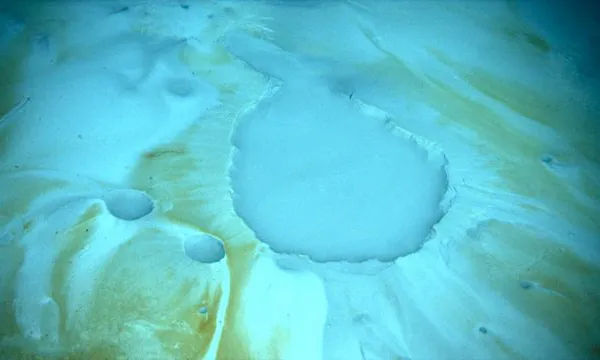
Photo: Lophelia II 2010 Expedition, NOAA-OER/BOEMRE National Oceanic and Atmospheric Administration - Ocean Exploration and Research / Bureau of Ocean Energy Management, Regulation and Enforcement, Public domain, via Wikimedia Commons
Picture a lake. Got it? Now picture it 3,300 feet underwater, at the bottom of the Gulf of Mexico, with its own shoreline, its own waves lapping against the sediment, and a briny surface that ripples when a robot submarine's thrusters disturb it.
That's not a metaphor. That's the Jacques Cousteau-named 'Jacuzzi of Despair,' and it kills almost everything that touches it.
How Does a Lake Exist Underwater?
It sounds like a physics violation, but it's really just chemistry with attitude. The brine pools of the Gulf form when ancient salt deposits beneath the seafloor — leftovers from a time when the region was a shallow evaporating sea — dissolve into seawater seeping through cracks. The resulting brine is four to eight times saltier than the ocean above it, and vastly denser.
Denser water sinks. So instead of mixing, the brine pools in seafloor basins like water pooling in a depression on land. From a submersible, it genuinely looks like a lake: defined edges, a visible surface, waves that ripple when disturbed. Researchers have described the surreal experience of hovering a sub over a shoreline that exists 60 feet below another body of water.
And it's lethal for a reason beyond salt. The brine is saturated with methane and stripped of oxygen. It's a chemical dead zone.
The 'Kill Zone' Footage
In 2015, a team aboard the research vessel Okeanos Explorer sent remotely operated vehicles into the pool and captured footage that became instant internet legend: a crab — later nicknamed 'Crabzilla' by viewers — tumbling down into the brine and struggling to climb out as the water scorched its shell. Mussels and small fish that wandered in didn't fare much better.
The pool's edge is littered with the shells of creatures that made it partway out. Scientists call the surrounding area a kill zone, and the footage earned the feature its grim nickname. Animals keep diving in anyway, likely lured by the bacterial mats and methane seeps around the rim — an all-you-can-eat buffet with a steep cover charge.
Life Finds a Way (Sort of)
Here's the twist that keeps microbiologists up at night: some organisms thrive in the brine. Extremophile microbes live in the pool itself, and tube worms and mussels colonize its edges, hosting symbiotic bacteria that feed on the methane. The lake is sterile in the middle and crowded at the banks — an ecosystem shaped entirely by a chemical boundary.
That's part of why researchers care. Brine pools are natural laboratories for studying life in extreme conditions, including analogues for early Earth and, potentially, for oceans beneath the ice of Europa and Enceladus — places where dense, chemically distinct water bodies may also exist under a larger one.
So the next time someone tells you there's no such thing as a lake in the ocean, you can tell them about the one in the Gulf of Mexico that has a shoreline, a wave pattern, a body count, and a name scientists gave it while laughing nervously: the Jacuzzi of Despair.