He Came Home From Space 311 Days Later — And Was Technically Younger Than When He Left
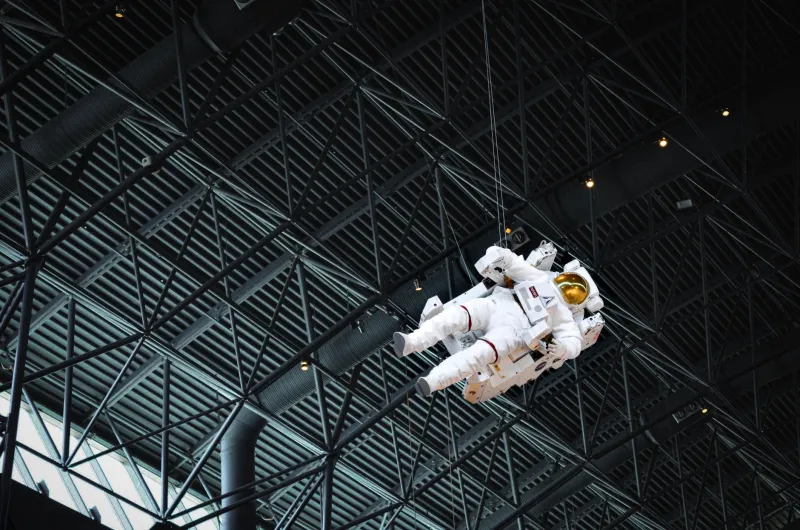
When Scott Kelly touched down in Kazakhstan in March 2016 after 340 days aboard the International Space Station, he was greeted with medical exams, handshakes, and the kind of exhausted relief that only comes from spending almost a year in a tin can orbiting the planet at 17,500 miles per hour. What nobody mentioned at the welcoming party — at least not out loud — was that Kelly had, by the cold logic of Einstein's theory of relativity, aged ever so slightly less than every single person who had stayed behind on Earth.
Not by much. We're talking about 0.007 seconds over the course of a nearly year-long mission. But here's the thing: that number is real. NASA calculated it. And the fact that it's real turns out to be stranger, and more philosophically thorny, than anyone expected.
Why Moving Fast Makes You Age Slower
Einstein's special theory of relativity, published in 1905, contains one of the most counterintuitive ideas in the history of human thought: time is not a fixed constant. It moves at different rates depending on how fast you're traveling. The faster you move through space, the slower you move through time. This isn't a metaphor or a thought experiment — it's a measurable, documented physical fact.
Astronauts aboard the ISS are moving so fast relative to the surface of the Earth that time, for them, genuinely ticks a little slower. Not enough to feel. Not enough to notice. But enough to detect with atomic clocks, which is exactly how scientists confirmed it.
There's a wrinkle, though. Relativity has two components that work in opposite directions for orbiting astronauts. Special relativity says moving fast slows your clock down. General relativity says being farther from a massive gravitational source — like Earth — speeds your clock up. For astronauts on the ISS, these two effects partially cancel each other out. The net result is that orbital travelers age very slightly less than people on the ground. The math works out to roughly 0.007 seconds saved per year in low Earth orbit, depending on the specific mission profile.
For Scott Kelly's 340-day mission, that means he returned to Earth a tiny fraction of a second younger than his twin brother Mark — who had helpfully stayed on the ground and served as a scientific control subject in one of the most unusual sibling studies in history.
NASA Actually Tracks This
Here's where it stops being abstract physics and starts being genuinely strange: NASA doesn't just acknowledge this effect in theoretical terms. The agency has, at various points, quietly factored cumulative time dilation into long-duration spaceflight records. This is partly a matter of scientific bookkeeping — if you're running experiments that require precise timing, you need to account for the fact that your clocks in orbit are running at a different rate than your clocks on the ground.
But it also means there exists, somewhere in the documentation of human spaceflight, a running tally of exactly how many microseconds each long-duration astronaut has effectively "saved" relative to their Earth-bound counterparts.
Most people, upon learning this, have one of two reactions. The first is pure wonder — the universe is so strange and beautiful that the act of flying fast enough, for long enough, can literally subtract measurable moments from your biological timeline. The second reaction, particularly among people with legal training, is: wait, does that mean something?
The Footnote Nobody Expected
In the years following several high-profile long-duration missions, a curious argument began circulating in aerospace legal circles — never formally adjudicated, never making headlines, but persistent enough to be discussed in at least one published law review article examining the intersection of physics and compensation law.
The argument went roughly like this: if an astronaut is employed by NASA, and if that employment demonstrably results in a quantifiable reduction in the astronaut's experienced lifespan relative to their peers — even if that reduction is measured in microseconds — does the employer bear any theoretical obligation to acknowledge that loss?
It sounds absurd. It is, in most practical senses, absurd. Seven thousandths of a second is not a compensable injury under any existing legal framework. But the argument took on a slightly more pointed edge in at least one case involving the estate of a deceased astronaut, where family representatives briefly raised the question of whether the cumulative time dilation effects documented across multiple long-duration missions represented a form of actuarial harm — and whether, if the government was going to calculate the effect at all, it should be obligated to do something about it.
Nothing came of it. Courts have not exactly been lining up to adjudicate Einstein's field equations. But the fact that someone, somewhere, filed paperwork that essentially argued a federal agency owed interest on stolen microseconds is the kind of detail that makes you stop and stare at the ceiling for a while.
What It Actually Means
The honest answer to what time dilation means for astronauts is: almost nothing, practically speaking. Seven milliseconds is not a retirement benefit. It won't show up on a life insurance actuarial table. Scott Kelly is not detectably younger than his twin in any way that a doctor could measure with available instruments.
But the principle is not nothing. Time dilation has been confirmed experimentally dozens of times. GPS satellites, for example, have to correct for relativistic time differences constantly — without those corrections, your navigation app would accumulate errors of several miles per day. The effect is real enough that engineers build it into the infrastructure of modern life.
What makes the astronaut version of this story so quietly remarkable is that it transforms Einstein's most famous equations from a physics lecture into something almost biographical. Every person who has spent extended time in orbit has lived, in the most literal sense possible, in slightly different time than the rest of us. They came home to a world that had aged a few microseconds more than they had.
That's not science fiction. That's Tuesday, at NASA.
And somewhere in a filing cabinet, there may still be a piece of paper arguing that those microseconds were worth something.